
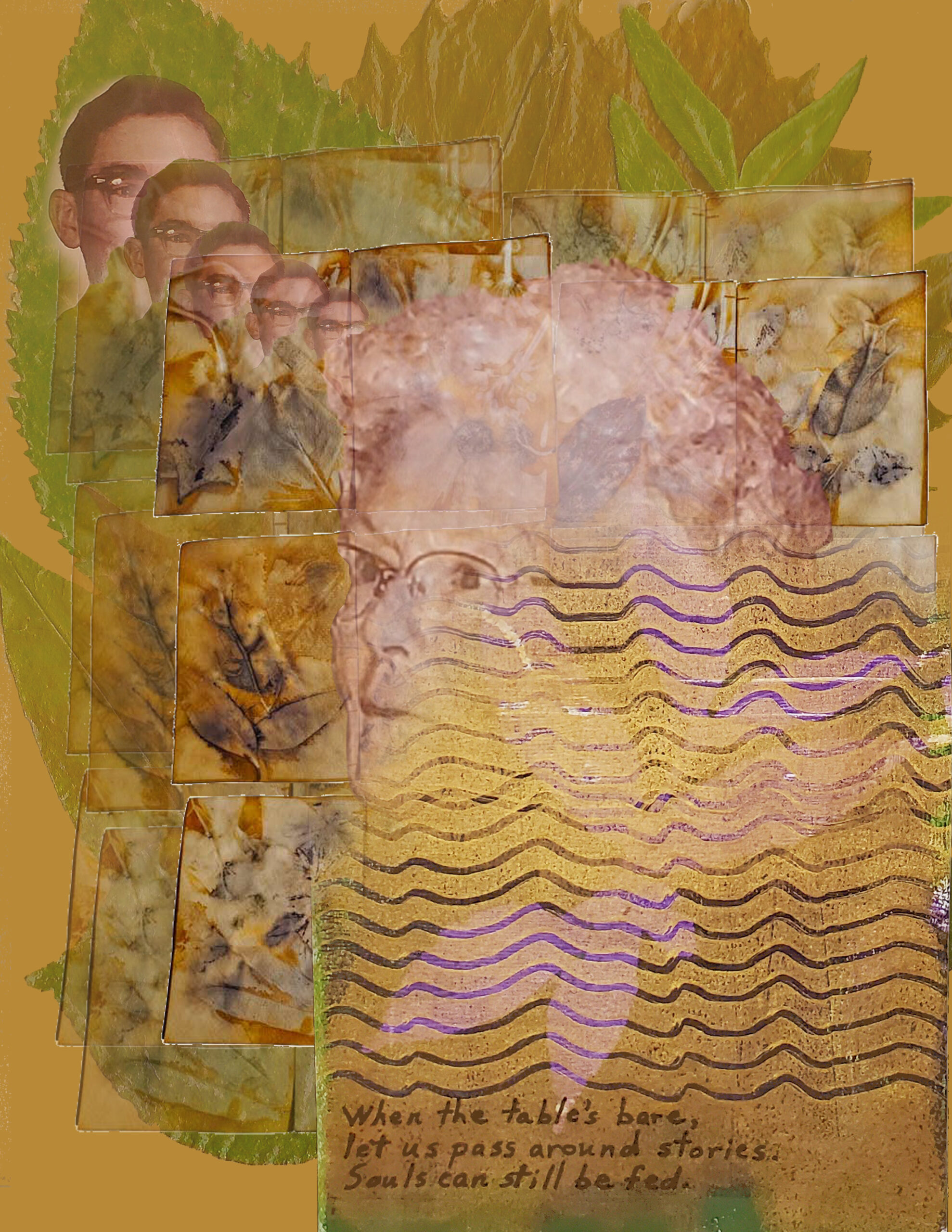
By five, the afterschool rush was over, and the students from the neighboring Seiberling Catholic Elementary had left a series of discrete messes in the children’s library. Lauren picked up scattered books and comics and placed them on a cart for Ted, the new page, to reshelve later. At one of the short, round tables, a bespectacled man sat with a toddler in his lap. He read aloud from a cardboard book: An octopus has eight legs — that’s six more than you! The girl’s laughter filled the room.
At the row of desktop computers, a boy in a maroon Seiberling uniform played a stuttering videogame. The computer hummed beneath mouse clicks and keyboard clatters. Lauren crouched behind him to pick face-down puzzle pieces off of the floor.
The five-hundred piece puzzle was set up at the activity center in the back of the children’s library. Next to the puzzle, there was a coloring station. Lauren took the crayons spilled across the table and put them with the rest in a chipped plastic cup. Underneath the crayons, a drawing had been discarded.
It was a child’s crude approximation of a man’s face. His head was a lopsided circle, sketched in one thick, waxy line, lacking ears or neck. He had no hair, owing to baldness, or to the limits of stick figure style. His eyes were bowl-shaped semicircles under big, uneven brows. He had low, narrow lips whose corners turned up in a little smile, and a thin rectangle nose. Between the two was the smeared ghost of a mustache. Everything but the eyes were drawn in black crayon. The eyes were blue, like pool water.
The subject could have been a parent, a teacher, or a character from a cartoon. He couldn’t have been newly imagined, because Lauren found him immediately familiar, even through his distortions. Looking at the drawing was like looking at a caricature of a friend.
She realized she had picked up the drawing and was holding it in front of her face.
The small children’s library was designed so that supervising adults could keep watch from any position. The walls not covered by bookshelves had posters promoting ecological awareness and common-sense safety. There were no windows, but very bright lights. Besides Lauren, the Seiberling boy, and the father and child, it was empty.
Lauren approached the father, who now read about a lonely trapezoid. She put the paper down on the table in front of him. Excuse me, is this yours?
The man looked at the face, then at her, blinking. His daughter saw the face and laughed.
Thank you, Lauren said and took the paper back to her desk. She put it next to a stack of new books and worked on the week’s coming programs. She texted Keith, asking what he wanted to do for dinner. I don’t know, he replied. They liked to cook together, him dicing vegetables, her seasoning globs of ground turkey, one of them stopping to flip a record in the dining room, both in black aprons they tied for one another. It had been a few weeks.
I’ll order some takeout, she replied and put her phone away. The presentation on her work computer failed to cohere. She added and deleted the same slides. Meanwhile, the man and his daughter left. A few other families stopped by. Lauren was happy to help them find fantasy novels and picture books on American history. Ted, across the room with an earbud in, reshelved the cart.
The library closed at seven. The boy from Seiberling stayed on the computer until six fifty-five. He forgot to log out, leaving the screen filled with his game: pink martian dunes, a yellow pyramid bright in the distance. Lauren shut it down before logging out of her own computer. Per administrative policy, she crumpled up the paper with the drawing, and placed it in the recycling bin.
On the bus, Lauren ordered Szechuan food for delivery, and found it waiting on her building’s porch. She carried the bag through the darkened apartment to Keith sprawled on the couch, TV flashing across his face blue and white. The sound was up loud and he was looking at his phone. Brushing away a tuft of hair, she kissed his forehead. He kissed her lips.
How was your day? She asked and he said Fine. All day long he was sitting in his home office or here on his couch, trying not to think. Nadine was such a sweet woman, always calling and sending gifts. She loved her son and treated Lauren like a daughter. She’d been in hospital for two weeks now. On Monday they put her on a ventilator. And after the first few days he was always fine.
Lauren brought two bowls of rice, crispy eggplant, and mapo tofu to the couch. He kissed her again and put on a cop show.
A glass-and-marble bank was held up by a gang in Greek theater masks. A pair of flirtatious detectives chased them to the sewers. Sometime between the first and second ad breaks, Lauren could only think about the face drawn in crayon. She no longer remembered the drawing exactly, but she could see the face it meant to capture. His head was shaped like an upturned teardrop, narrow at the chin. He was bald, white, with sunken cheeks and a heavy brow. Red rash marks splotched the left side of his face. His eyes were hooded and very blue indeed.
The face was clear, but she could not remember his body. He was thin or fat or horribly muscular. His disembodied head hung like a moon in the void of uninterrupted thought.
Lauren washed the bowls and took out the trash. She and Keith brushed their teeth and climbed into bed. They lay awake, unspeaking. The rotary fan on the nightstand buzzed in the dark. Keith put his hand on her thigh and kept it there. Lauren was slow to open her eyes. She stared up at the ceiling and felt her blood under his palm.
He was looking at her, and she looked at him, cold in the eyes and somewhere far away. At this, he kissed her, squeezed her thigh, trailed his hand up under her cotton shorts and underwear. He fingered her with his hand clenched so stiff his knuckles bulged. She made noises for his benefit. But she was thinking of Nadine, that sweet Southern lady, covered in wires and tubes, jaw broken so the ventilator could fit.
He stopped touching her, rolled to his knees, and jabbed his red penis in her face. His crotch smelled like the ocean. Willing her mind into a blur, Lauren took him in her mouth. Suddenly the misty dark inside and the blue nighttime haze merged, and she could only see the stranger’s face in front of her. Lauren became cold all over.
#
Nannies and parents with strollers lined the ramp up to the Fleming Branch Library. A few greeted Lauren as she unlocked the door, stepped inside, and locked it behind her. Ten minutes, she mouthed, flashing open palms behind the glass doors. She clocked in up front and made her to the children’s library in the back.
Before logging onto her computer, Lauren rolled her chair over to the edge of her desk and picked up the blue recycling bin. Propping the bin in her lap, she started taking out papers. There were forms for the month’s reading challenge and drawings from the coloring station. The drawings showed naive street scenes, family portraits, animals real and imagined. She looked through them all and couldn’t find the man’s face. She shoved the papers back into the bin, shook it with both hands, and took them out again. Ted was giving her a look from the corner of her eye, and she still checked each paper. The drawing was gone.
Every Thursday morning, Lauren hosted a program where for thirty minutes she sang and read aloud to babies in the building’s conference room. Behind her, the previous night’s slides provided colorful backdrops for her performance. She glanced at them to remember her program and saw, or imagined, without much feeling one way or another, the judgement of the gathered adults.
When she finished and the room was empty, Lauren found she’d missed a text from Keith. Going 2 hospital after work. Might be home late. Unable to think of a reply, she gave the text a ‘heart’.
Back at her desk, Lauren found the janitor had already emptied the recycling bin. Shadows pooled below the bin’s clear plastic lining. She made herself concentrate on book orders and outreach forms. Parents brought their kids to her by hand and asked them to ask her for help finding little books on Thanksgiving, construction vehicles, volcanoes.
Lauren kept an eye on the coloring station. If she tried to ignore it, time slowed, her skull began to itch, white circles flickered in the shutter of an eyeblink. She gave into the magnetic pull of the little gypsum table. When children sat there doodling, she found an excuse to tidy up the room and glance discretely over their shoulders. Their pictures were colorful and flat. Every one of them ended up in the recycling bin.
Lauren took off her shoes in the empty apartment and headed straight into Keith’s office. The white walls were covered in bookshelves and the poster for a film. She took a sheet of paper from his printer and a chewed pencil from a desk drawer. Pushing aside his mechanical keyboard, she put the paper on his desk in landscape and spread her elbows out past its sides.
Its blank expanse stared up at Lauren. She never considered herself much of an artist. But she saw the face and then it was there. She sat in Keith’s chair, looking at it, etched and shaded, and the pencil was rolling across the desk, and her hands were trembling against her thighs.
Outside it was dark. Rain was coming down hard. Lauren turned on a lamp in the living room. She sat on the couch, moved to the table, sat back on the couch. She looked at her phone, opening and closing the same apps, feeds scrolling by, nothing registered. Faint guitar music trickled down from the upstairs apartment and mixed with the roar of the storm and the hum of all of the idling electronics. Lauren didn’t cook or eat anything. When she stopped hearing the music upstairs, she turned off the light and got in bed.
Eleven P.M., rain on the window, no word from Keith. Lauren couldn’t remember if she’d ever slept in the apartment alone. She thought of him in the hospital, white tile, lights so bright they’re diamond-blue, polished sinks and curtain rods. Nadine was asleep, cocooned in a cyborg apparatus, and Keith stood with his head lowered to her as if fixed by a taut chain. His eyes were bleary red watching her stomach rise and fall, rise and fall again, the sound of the rain an air-conditioner rumble, vital signs beeping to a little green squiggle. He nursed a coffee, held her hand, no other children and her husband dead twenty years and counting. The whole room shimmered as if wracked by fever. Lauren stood far down the hall, watching everything through a little window growing smaller.
Through the window Lauren saw a yellow chamber. The walls were lined with pictures and the ceiling could be the sky. Twelve again, in her mother’s office, a big map of Europe on the wall and the fan chopping shadows across the ceiling. She sat at the computer with the square monitor bigger than her head. Inside, the pictures on the walls were in silver square frames. Each one was a photograph of a girl or boy, all her age or just a little older. One had braces. She didn’t recognize any of them.
At the end of the chamber there was a small, indistinct cube. On approach, the cube revealed its particularities. It was a slotted wooden cage. The cage was empty and the door was open. Padlocks dangled from metal bars on the top and bottom of the door. Lauren was walking towards this even though it scared her. She felt she didn’t have a choice. Breathing loud behind her. She could turn and look, but she didn’t want to. If she saw him–
Lauren was awake and his face hung above her. He was fuzzy in the shadows, but his eyes were bright and clear. Unblinking, the face retreated into the ceiling as if sinking into mud. The eyes were the last to go. They left a negative image burned into the textured night. Then darkness gathered around the ceiling like smoke.
Keith was snoring beside Lauren. His back was turned, his shirt was off, the ridge of his spine curled between his shoulders. Momentarily blinded by the light from her phone, Lauren rubbed her eyes and saw it was just after three.
Caught in the glow of the open refrigerator, she poured herself a cool glass of water and a bowl of cereal. She placed them on the kitchen table beside her closed laptop. The rain had lightened, tapping gently on the window. Eating by the light of blurred streetlamps, she remembered in bits and flashes.
Lauren had first known the face in a game. For a few months or a year, this game was her buoy. The time in which she was hooked coincided with a time that was so difficult for such a protracted period, that it was all but impossible to recall. But she could see herself in the third person sitting at her mother’s computer, in her office with the fan and the big map of Europe, playing this online game without combat or puzzles or much of a goal at all. There were pearl castles, labyrinthine car parks, oceans full of neon crabs. Everyone was proportioned like articulated drawing mannequins with lightbulb-shaped heads. Lauren was a lithe boy with white, spiky hair. She gave him red eyes and ridiculous clothes. She went to parties and weddings. She danced in rainbow light. She built things: houses, pools, little Parisian cafes. She must have played it every day, and hadn’t thought about it in twenty years or more.
Lauren opened the laptop and double-clicked her browser. She searched: 2005 online game chatting and saw a page of unfamiliar titles. She searched for early 2000s online game old man face and clicked a few lists of X Nostalgic Games You Forgot All About without recognizing any of them. She searched for online game yellow room, chat game 2005 old man, and other combinations thereof. Without quite knowing why, she tried: online game yellow pyramid and froze.
The first result was a YouTube video. The thumbnail showed a yellow Mesoamerican pyramid rendered in simple 3D geometry. The man’s face was digitally superimposed over it, near-translucent, like a fog. The video was titled Cult in an Old MMO?
#
By five, the afterschool rush was over, and the students from Seiberling Catholic Elementary had made a mess of the children’s library. Lauren enlisted Ted to help gather the thin books scattered across the patterned carpet. One of the books lay splayed open, spine cracked and trampled. Lauren placed it on her desk for further assessment. Her phone buzzed: a message from Keith. Out of tilapia. Salmon OK?
Ted put the remaining books on a cart and sorted them by reading level. Lauren flipped through the damaged book, one Illinois Creepy-Crawlies, and a full-color page fell out. She searched the database for the title and found six more copies in the system. So this one was deleted, the barcode scratched out with a felt pen, a black DISCARD stamped across the title page, twice.
Lauren surveyed the room. Ted was sorting the books and three boys in Seiberling uniforms sat before three desktop computers. They all wore headphones or earbuds and they all played different games. The clattering of the keyboards and rhythmic clicking of the black plastic mice were the only sounds they made. The din became one with the hum of the air-conditioning unit and sunk into the room.
An inbox of read emails lay static on Lauren’s computer. The cart was empty, pressed against the wall. Ted was somewhere further in the building; two of the three boys had left the computers. The last still sat playing his game. He leaned forwards in his chair, shoulders pinched, small head and large black headphones eclipsing the screen. Lauren noticed it was nearly seven and nothing had been done.
A woman’s voice called Lewis! or Lucas! and a chair scraped against the floor. The boy was gone, but his footsteps lingered.
As usual, he forgot to close out of his session. After Lauren tidied up the drawing station, she stopped by the computers. The boy’s game scored a rectangle on a flat screen. The window provided a first-person view of a blocky meadow at dawn. A yellow pyramid shone in the distance.

Previous writing has been published in minor literature[s], Vastarien Magazine, and ergot.press.
